Open this article in your preferred AI tool and ask it to summarize the key points.


Why we build simple robots
Guest post by Brightpick CEO Jan Zizka
In robotics, complexity is tempting.
More joints, more sensors, and more sophisticated grippers can make a robot appear more capable. In a controlled demo, that complexity can be impressive. But in real-world operations, each additional component adds cost, maintenance, and another potential point of failure.
At Brightpick, we made a deliberate choice early on: build mechanically simple robots and use AI and software to make them highly capable.
That decision has shaped our entire system architecture.
Operators buy outcomes, not complexity
Before designing any robot, you first need to understand the problem it is meant to solve.
For warehouse or factory operators, the objective is never simply to pick an item or move a product from one place to another. The objective is to perform that task reliably, efficiently, and at a lower cost.
That means optimizing for outcomes such as uptime, throughput, and accuracy, rather than for the technical sophistication of the robot itself. The right system is the one that consistently delivers the outcomes each operation requires with as little unnecessary complexity as possible.
Then there is cost. For most buyers of automation, the most important metric is return on investment. What matters is not absolute performance in isolation, but the amount of useful performance delivered for every dollar invested. That includes not only the upfront price of the system, but also the ongoing costs of maintenance, spare parts, service, and downtime.
Simple hardware improves this equation. A robot with fewer mechanical parts not only costs less upfront, but also has fewer components that can break, drift, or wear out. This helps increase uptime, reduce service costs, and simplify deployment, further lowering the system’s total cost of ownership.
Our hardware stack
At Brightpick, this philosophy is reflected throughout our hardware stack.
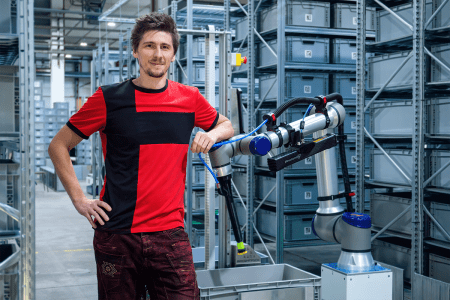
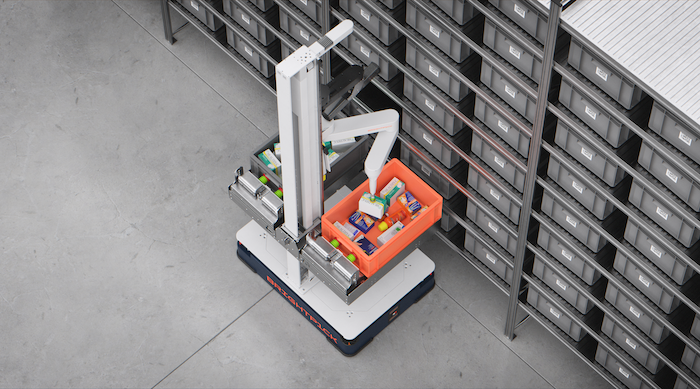
- Robotic arms: Our robots use simple two-axis SCARA arms with only the motion required for reliable tote picking. Additional joints would expand the robot’s range of motion, but they would also add cost, maintenance, and more potential points of failure, with minimal benefit to performance.
- End-effectors: We use vacuum grippers instead of fingers because they are simpler, more durable, and effective for the vast majority of warehouse products. Many of our robots also carry automatic gripper exchangers, allowing them to select from multiple suction cup sizes based on the item being picked.
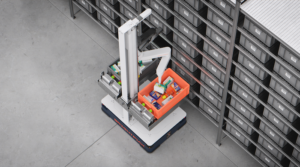
- Locomotion: Our robots use wheels instead of legs. Warehouses have flat floors and structured operating environments, so wheels provide fast, reliable, and energy-efficient movement without the mechanical complexity required for legged locomotion.
- Storage: We store and pick products from totes, which create a more consistent and controlled picking environment. This enables our robots to achieve higher throughput and reliability than they could by picking directly from shelves.
- Form factor: We rely on a single robotic form factor that can perform all fulfillment workflows, rather than building multiple specialized machines. Customers do not need a different type of machine for every process, and we can improve one shared platform across the entire fleet.
Together, these choices make our robots less expensive to build, faster to deploy, and easier to maintain. This approach has helped us scale to more than 500 robots in production while maintaining >99.9% uptime and meeting the performance requirements of diverse customer operations.
Simple robots need smarter software
Keeping the robot mechanically simple does not make the engineering challenge disappear. It moves many of the hardest problems into software.
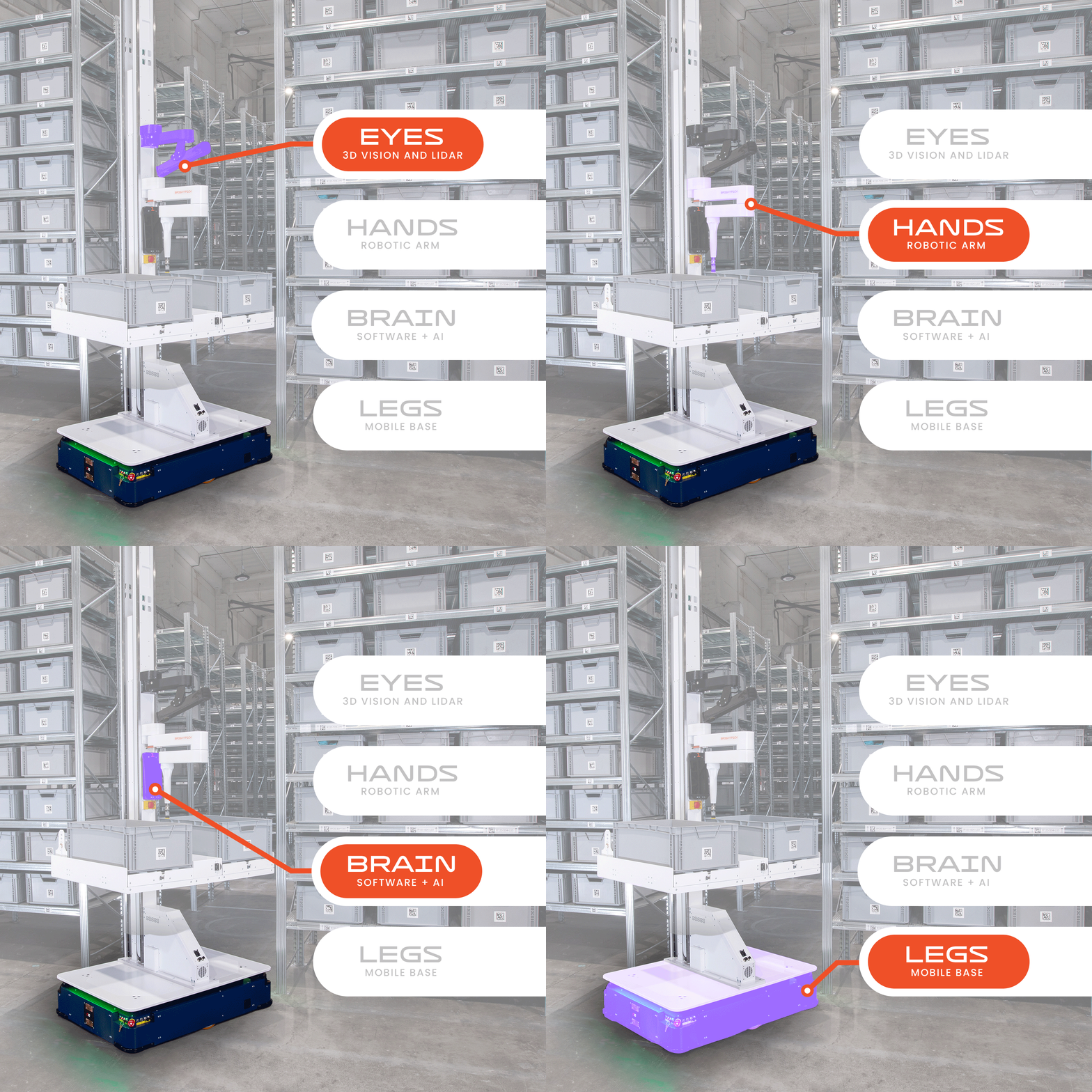
To make simple hardware perform at a high level, we developed Brightpick Intuition, our unified physical AI and fleet orchestration platform. Intuition enables our robots to perceive products, execute reliable picks, navigate through the warehouse, coordinate across the wider fleet, and respond when something does not go as planned.
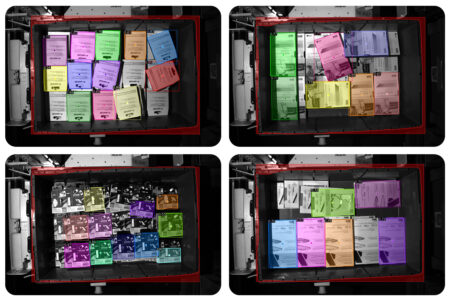
For manipulation, Intuition combines visual and tactile intelligence. The robot uses 3D vision to understand the position, shape, and orientation of products, then monitors pressure, airflow, and suction to confirm that each item has been picked securely. Most picks are executed by a lightweight neural network running directly on the robot, while more difficult picks are escalated to a larger VLA model hosted at an on-prem server or, in rare cases, completed through human-assisted fallbacks.
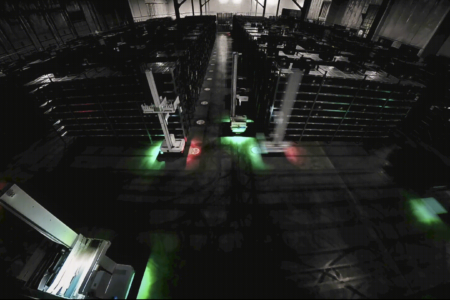
We take the same approach to navigation. Brightpick robots use LiDARs and SLAM to move freely without fixed infrastructure such as QR codes or magnetic tape. This makes the robot more intelligent while simplifying the warehouse around it.
The goal is not to eliminate complexity. It is to place complexity where it creates the most value: in software that can continuously improve and be deployed across the entire fleet, rather than in mechanical components that add permanent cost and maintenance.
Simplicity pays
Building simple robots does not mean avoiding hard problems. It means solving them in the right part of the stack.
We could add more joints, sensors, and sophisticated grippers. But every additional layer of mechanical complexity affects reliability, maintainability, and cost.
In automation, complexity has to earn its place. If a simpler robot can deliver the required performance through better AI and software, it is usually the better long-term solution.
Customers are not ultimately buying technology, or even robots. They are buying throughput, reliability, and lower operating costs.
That is why we build simple robots. Not because the problem is simple, but because the best production systems often are.
About Brightpick
Brightpick is a leader in AI-powered robotic solutions for warehouses. The company’s multi-purpose AI robots enable warehouses of any size to fully automate order picking, buffering, consolidation, dispatch, and stock replenishment. The award-winning Brightpick solution takes just weeks to deploy and allows companies to keep their warehouse labor to a minimum. With offices in the US and Europe, Brightpick has more than 250 employees and hundreds of AI robots deployed with customers.
- SHARE
-

-
-
-


- SHARE
-
-
-
-