Open this article in your preferred AI tool and ask it to summarize the key points.


Our multimodal AI picking stack
Robotic picking can look deceptively simple: find the right item, pick it up, and place it into an order.
In a real warehouse, however, robots encounter thousands of different products, from soft bags and small boxes to fragile bottles and irregularly shaped items. Products overlap, packaging bends, and items move inside totes.
A robot must understand not only what it sees, but also what it touches, whether the action succeeded, and how to respond when something goes wrong.
Intuition, our multimodal AI picking stack, brings these capabilities together in a closed-loop system that continuously checks and adapts throughout the picking process while learning from each pick.
Here are the key forms of intelligence that make it work.
Visual intelligence
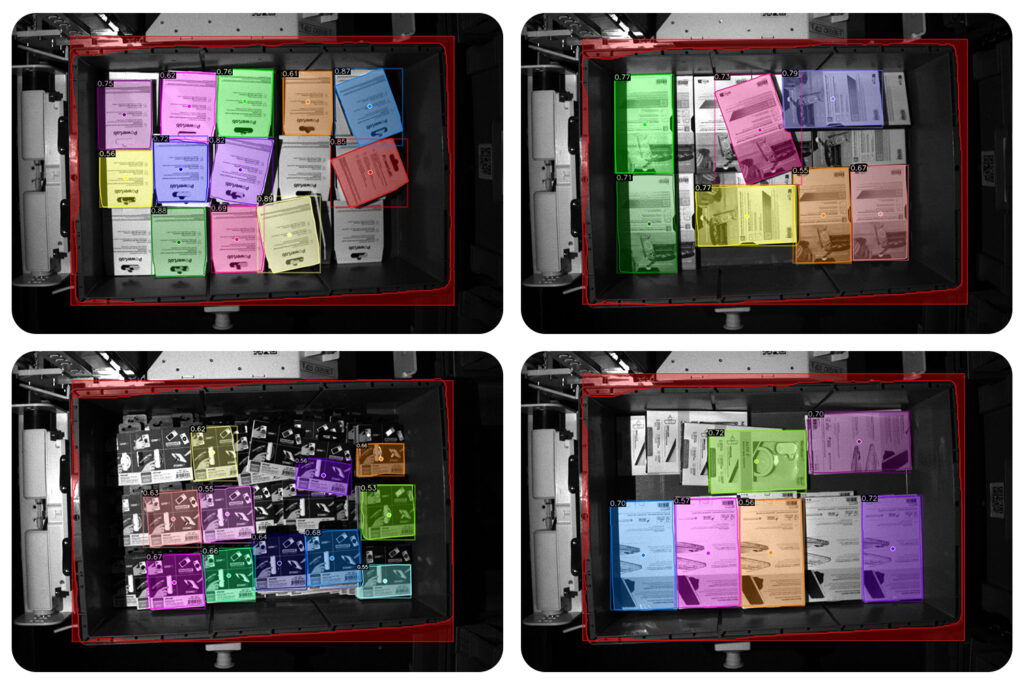
Brightpick’s visual intelligence starts by building a detailed 3D point cloud of the tote and its contents. Depth sensing captures the shape and position of the items, while object segmentation separates individual products, even when they overlap or partially cover one another.
The AI estimates each item’s geometry and orientation, evaluates the surrounding space, identifies the optimal pick point for each item, and assigns each pick point a score to select the one with the highest probability of success. This allows our model to adapt each pick to the actual arrangement inside the tote rather than relying on predefined SKU data or pick points.
Tactile intelligence
As the gripper engages the item, integrated pressure sensing confirms contact and enables the robot to precisely modulate downward force until a secure suction seal is established for a reliable pick. A firmware-level safety threshold prevents excessive force, while airflow can be adjusted for different items depending on weight, shape, and packaging. The robot monitors suction throughout the pick to ensure the item stays securely held until placement.
In addition, oftentimes our robots carry automatic gripper exchangers, which enable them to select the best suction cup for the given item, broadening the range of robotically pickable SKUs.
Intelligent placing
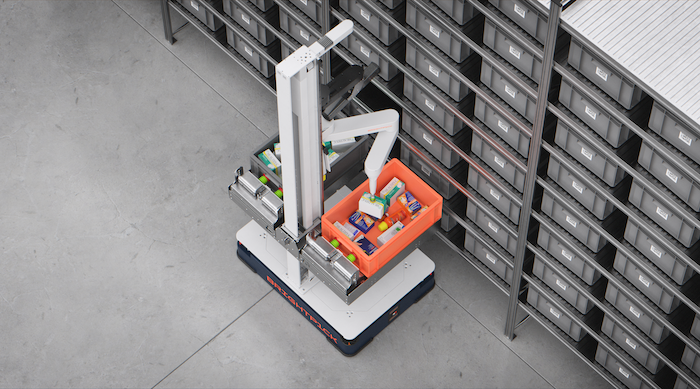
When needed, the robot can scan the destination container and delicately place the item in the most optimal position. This is especially useful when handling fragile products or items with significant differences in weight, helping prevent heavier products from being dropped or placed on top of lighter, more delicate ones.
Intuition considers the item’s size, shape, weight, fragility, and the stability of everything already inside when determining the placement action. With pick-to-shipper, products can be placed directly into the final shipping container – reducing intermediate handling and additional packout workflows while maximizing the use of available space and limiting risk of damage.
Model architecture
Brightpick uses a two-stage approach to complete picks autonomously. The first attempt is handled by a lightweight neural network with 30 million parameters running directly on the robot. This enables fast, low-latency processing and achieves a success rate of over 98%.
If the first attempt is unsuccessful, the robot switches to a larger VLA model hosted on each warehouse’s on-site server. It combines a 3-billion-parameter backbone with a 300-million-parameter action expert and guides the robot through its next attempts. Together, these models achieve a pick success rate of over 99.7%.
Human-in-the-loop fallback
In the rare cases where an item remains too difficult to handle reliably, the robot makes up to three pick attempts before falling back to two possible human-assisted fallbacks:
- Remote teleoperation: An operator remotely guides the robot through the pick.
- Goods-to-person station: The tote is sent to a staffed workstation, where an operator completes the pick manually.
This ensures that, operationally, all orders can still be fulfilled without critical failure.
Turning every pick into a lesson
Each pick records what the robot saw, the action it chose, the result, and how any exception was handled. Successful picks, retries, failures, double-picks, and human interventions become training data. Each manual intervention creates a valuable datapoint that helps train Intuition to handle similar edge cases autonomously in the future.
Reinforcement learning rewards outcomes that matter in warehouse operations, such as completing a pick safely, avoiding damage, and minimizing retries. Over time, the system learns better grasp points, trajectories, gripper choices, and airflow settings. It can even learn to rearrange cluttered items when no viable grasp is available.
Because this data is collected across hundreds of robots, each software update improves performance across the entire fleet, not just a single robot. By combining these capabilities on simple, cost-efficient hardware, Brightpick can automate more work reliably while improving uptime and reducing the cost per pick.
About Brightpick
Brightpick is a leader in AI-powered robotic solutions for warehouses. The company’s multi-purpose AI robots enable warehouses of any size to fully automate order picking, buffering, consolidation, dispatch, and stock replenishment. The award-winning Brightpick solution takes just weeks to deploy and allows companies to keep their warehouse labor to a minimum. With offices in the US and Europe, Brightpick has more than 250 employees and hundreds of AI robots deployed with customers.
- SHARE
-

-
-
-


- SHARE
-
-
-
-