Open this article in your preferred AI tool and ask it to summarize the key points.


Why mobile manipulators are taking over warehouses
Guest post by Brightpick CEO Jan Zizka
For the past 30 years, automated warehouses have been designed around what robots could not do.
The first generation of warehouse robots became very good at moving inventory. They would transport shelves, retrieve totes, and carry products between different parts of a building. But they could not perform the most important step in fulfillment: picking the product itself.
The entire industry designed around this limitation. Instead of sending a robot to pick the product, traditional automation brings the product to a fixed picking station, where a person or stationary robotic arm then completes the pick.
This goods-to-person model represented a major improvement over fully manual operations. But it also created an architecture in which enormous amounts of equipment, energy, and time are dedicated to moving inventory back and forth.
Mobile manipulation is beginning to change that.
Warehouses designed around transportation
Imagine shopping in a grocery store where, instead of walking through the aisles with a cart, you had to bring every individual product to the cashier before choosing the next one.
You select a box of cereal, carry it to the checkout, then go fetch the next product. You do the same for a bottle of milk, a bunch of bananas, and every other product in your order.
That is essentially how automated fulfillment works today.
For each pick, inventory must travel out of storage to a fixed workstation. Once the item is picked, the remaining inventory travels back into storage. The same process repeats for the next item. Anyone who is familiar with the traveling salesman problem immediately sees just how inefficient this is.
As volumes grow, warehouses need more robots, conveyors, and picking stations to support all this movement. Robots compete for access to the same workstations. Congestion increases. Picking stations become bottlenecks. Infrastructure costs rise.
Traditional automation made transportation highly efficient, but transportation was never the customer’s goal. The goal was to pick and fulfill orders.
The industry optimized movement because robots were not yet capable of doing all the work themselves.
Bringing the robot to the product
Mobile manipulators combine mobility with item manipulation.
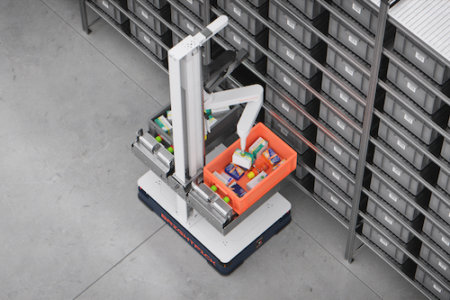
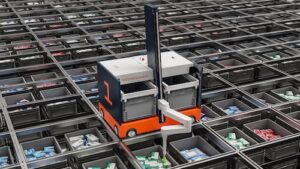
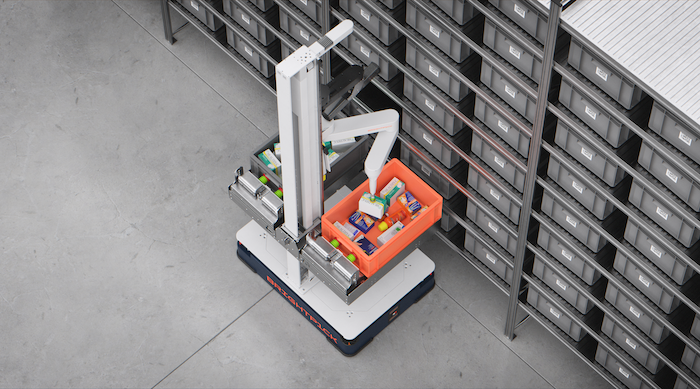
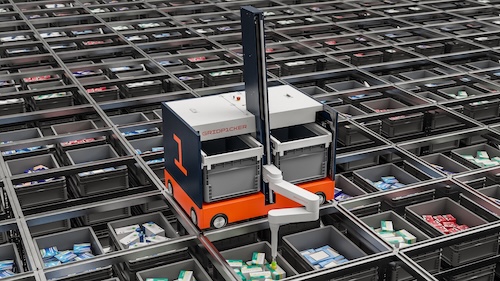
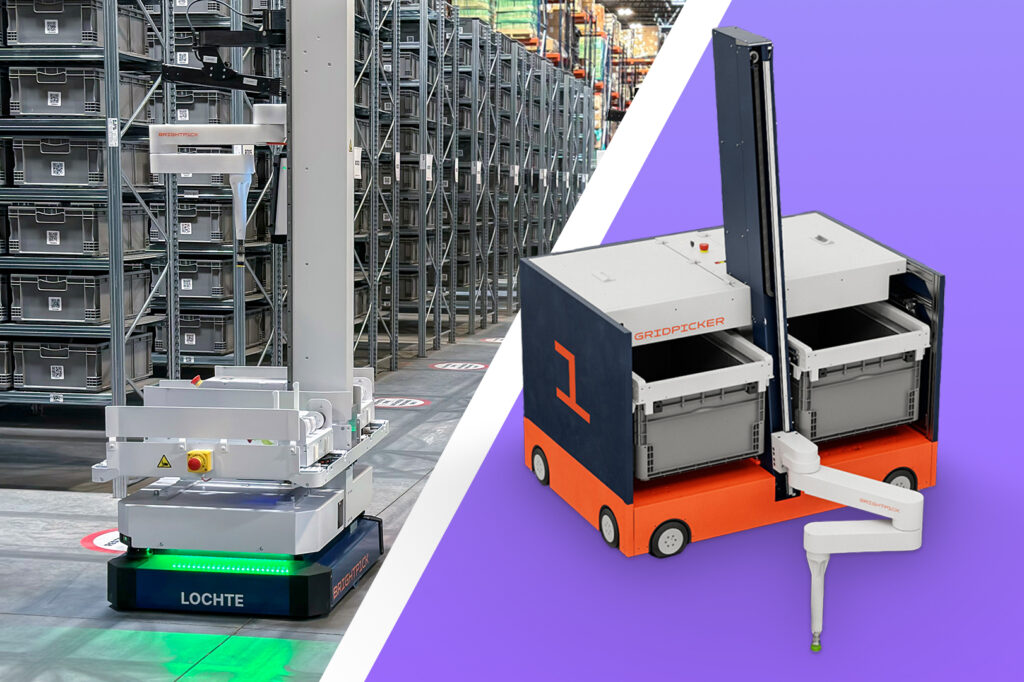
Instead of merely transporting inventory, they travel to where products are stored and perform the pick directly inside the storage area. The robot retrieves the required tote, identifies the correct product, picks it, and places it into an order container without having to carry the inventory to a fixed picking station.
This changes the economics of automated fulfillment.
When picking happens inside the storage area, robots spend less time transporting inventory and more time picking. Based on our simulations and data from real installations, this increases robot productivity by 2-3x compared to traditional goods-to-person robots:
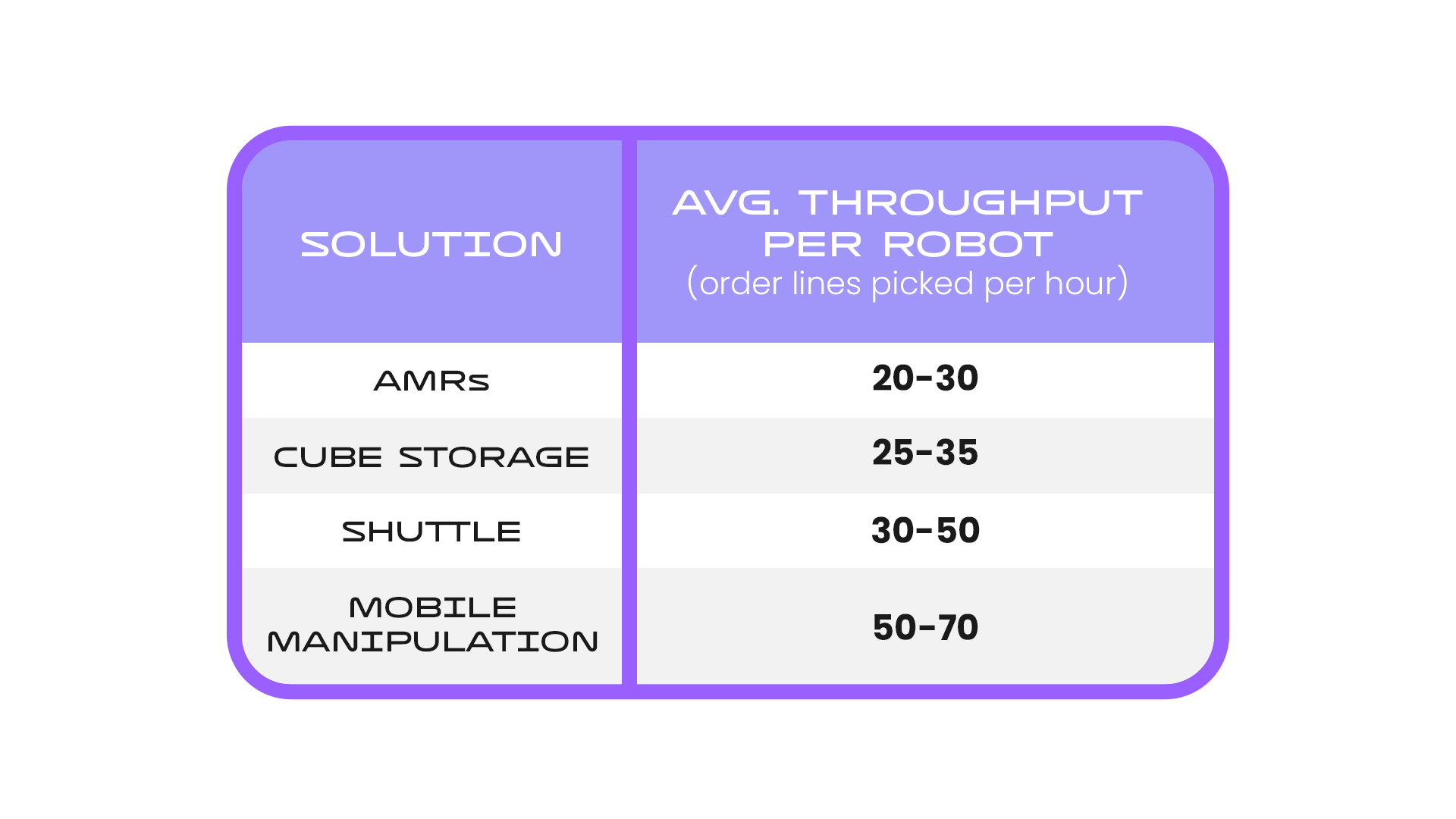
Higher productivity per robot means fewer robots are needed to deliver the same throughput, which reduces total solution cost.
Fewer robots also mean less traffic inside the storage area and around shared workstations. This reduces congestion and allows the system to support higher maximum throughput out of a given warehouse space:
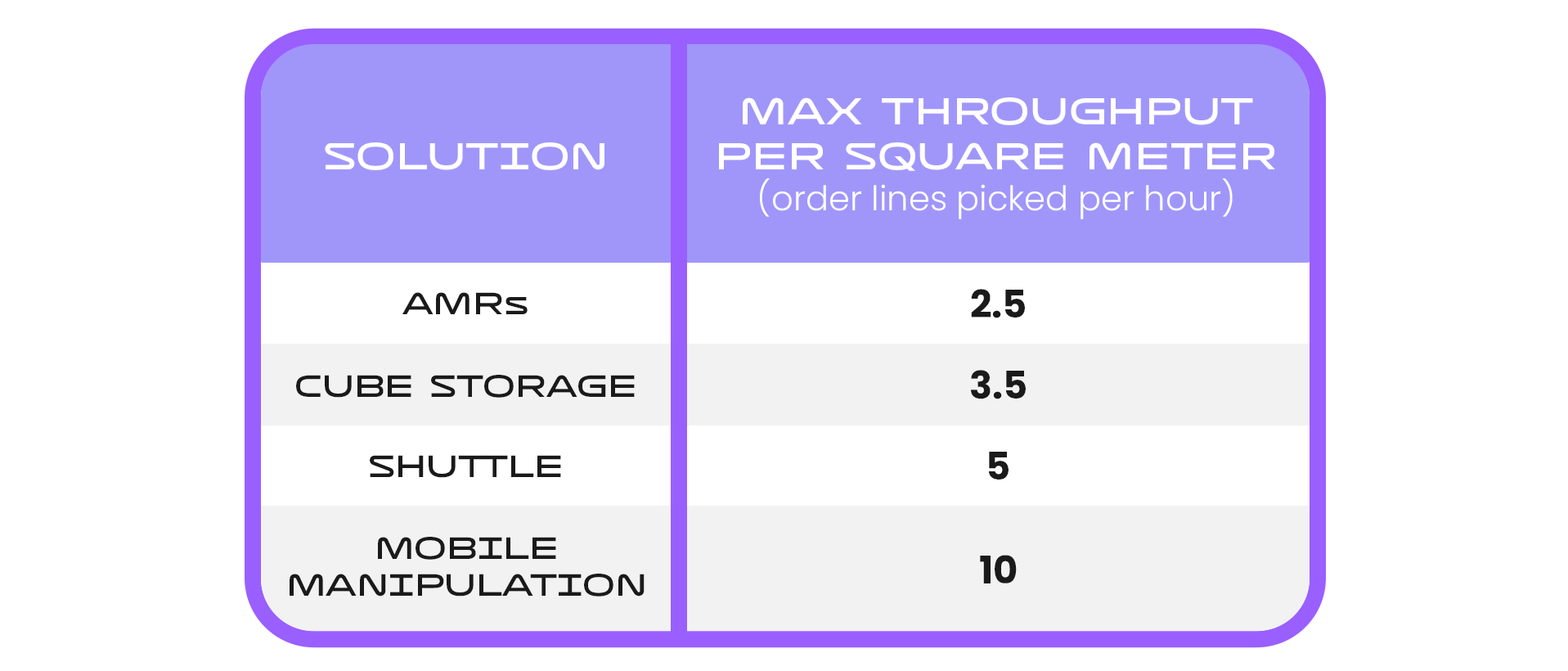
By automating picking in addition to storage and retrieval, mobile manipulators reduce the number of fixed picking stations required, along with the labor, infrastructure, and cost associated with operating them.
The first generation of warehouse robots automated transportation. Mobile manipulators automate the work itself.
Why this is becoming possible now
The idea of a robot that can move through a warehouse and pick products is not new. The technology required to do it reliably and economically is.
Until the 2020s, mobile manipulation remained largely an academic or experimental category. Robots could perform impressive demos, but deploying them in production warehouses exposed two fundamental limitations.
1. AI was not capable enough
Picking a product in a controlled demo is very different to reliably handling the enormous variety found in a real warehouse.
A robot may encounter products with thousands of different shapes, weights, materials, and packaging types. Items overlap inside totes. Bags deform. Bottles move. Packaging changes. Products may be reflective, transparent, damaged, or partially hidden.
Every tote presents a new arrangement, and the robot must know what to pick, where to grasp it, and whether the attempt succeeded.
Earlier machine learning models could be programmed to handle a limited number of known products and predefined situations. But they could not generalize reliably across the millions of potential SKUs and constantly changing conditions required for warehouse fulfillment.
2. The hardware was too expensive
The hardware capable of performing complex manipulation was also difficult to deploy economically.
Industrial six-axis arms, sophisticated grippers, and extensive sensor systems could achieve impressive results, but they were expensive, mechanically complex, and difficult to maintain at scale. Lower-cost hardware, meanwhile, was not capable or reliable enough to deliver the required performance.
This meant mobile manipulation could work technically, but not at a cost that made sense for large production fleets. The economics of mobile manipulation depend on keeping the robot mechanically simple. Doubling robot productivity creates little economic value if it also doubles the cost of the robot.
Advances in AI, 3D vision, sensing, and robotic hardware have changed both sides of the equation.
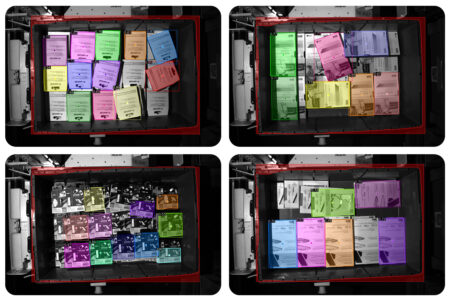
Robots now build accurate 3D point clouds of a tote, distinguish between overlapping products, identify suitable grasp points, and adjust their actions using visual and tactile feedback. When a pick fails, the system can try a different approach, escalate the task to a larger AI model, or use a human-assisted fallback.
At the same time, better AI has allowed mechanically simpler and lower-cost hardware to perform tasks that previously required far more sophisticated machinery.
Most importantly, the intelligence continues improving with every robot deployed. Each successful pick, failed attempt, and human intervention generates data that is used to improve performance across the entire fleet.
This creates a fundamentally different improvement cycle from traditional mechanical automation. A shuttle or conveyor delivers the same performance throughout its lifetime. By contrast, an AI-powered mobile manipulator can become more capable through software updates without requiring physical modifications.
For example, in 2026 we rolled out a new feature called picking-in-motion, which allows our Autopicker robots to complete a pick while moving toward their next pick location. It was a pure software update, yet it increased productivity per robot by up to 15%.
A new warehouse architecture
Goods-to-person automation was created because robots could move inventory long before they could understand and manipulate it.
That limitation is disappearing. Mobile manipulation is a new system architecture, not a single robot design.
Brightpick was the first to commercialize mobile manipulation at scale. We unveiled our Autopicker robot in 2023, and today we have more than 500 deployed with customers on multi-year contracts.
At The Feed, our robots have enabled fully lights-out night shifts. At Dr. Max, mobile manipulation has reduced labor to a single person overseeing dozens of robots and thousands of picks per hour. At Superior Communications, Autopicker has achieved throughput of up to 100 picks per hour per robot.
In the meantime, several other players have emerged with similar concepts, not to mention the myriad of humanoid pilots, all of which are also a form of mobile manipulators. As companies become more attuned to the benefits of mobile manipulation, expect more production-ready solutions to emerge.
The question is no longer whether mobile manipulation can work. It is where it should be deployed first. Traditional goods-to-person systems will not disappear overnight. They will continue to make sense for certain facilities and workflows. But the share of warehouse activity handled by mobile manipulators will grow as robotic picking improves.
We are still in the early stages of that transition, but the direction is already clear: mobile manipulation is becoming the new architecture for automated fulfillment.
About Brightpick
Brightpick is a leader in AI-powered robotic solutions for warehouses. The company’s multi-purpose AI robots enable warehouses of any size to fully automate order picking, buffering, consolidation, dispatch, and stock replenishment. The award-winning Brightpick solution takes just weeks to deploy and allows companies to keep their warehouse labor to a minimum. With offices in the US and Europe, Brightpick has more than 250 employees and hundreds of AI robots deployed with customers.
- SHARE
-

-
-
-


- SHARE
-
-
-
-