Open this article in your preferred AI tool and ask it to summarize the key points.


When Robots Don’t Sleep
Guest post by Brightpick CEO Jan Zizka
Robots do not need to sleep. But many automated warehouses still operate as if they do – stopping productive work when the staff goes home.
For all the progress in warehouse automation, much of it remains brittle. Machines can repeat a task thousands of times, yet an unfamiliar product, an inventory mismatch, or a piece of trash blocking an aisle can leave a robot frozen until someone intervenes.
In many cases, automation also relies on people for the most complex tasks in between, such as picking and packing. Automating the movement of goods does not create an autonomous operation if people still need to complete the next step. That is why so much warehouse automation remains tied to humans being around.
That is beginning to change. And AI is a major reason why.
Getting better at handling variation
In the 2010s, much of the progress in robotics came from applying machine learning to specific problems. At my previous startup, Photoneo, we combined advances in 3D vision with machine learning to help robots interpret complex scenes, for example distinguishing overlapping objects, identifying items under difficult lighting conditions, and handling reflective surfaces.
Today’s wave of AI is expanding what robots can learn from that experience. Rather than developing a narrowly trained model for each task or environment, we can increasingly train models on broader datasets and transfer what they have learned to new objects and situations. Robots can handle more variation without requiring a separate solution for every case.
One clear example is robotic item manipulation. Moving goods through a warehouse is a solved problem. The harder challenge is handling the individual products themselves. Here, multi-modal AI that combines vision and tactile is making huge leaps, especially in unstructured environments with high product variability such as warehouses.
Today, our robots can already pick the vast majority of products across pharmaceutical, apparel, and general e-commerce. I am confident that within three years, we will reach 100% robotic coverage across all applications, including in grocery and manufacturing, in addition to also solving packing and decanting.
The payoff goes beyond automating individual tasks. Combined with storage and transportation, these capabilities ensure end-to-end automation from incoming inventory to finished orders, removing the manual handoffs that still tie automated systems to a staffed shift.
Capability is not the same as autonomy
But we do not need to reach 100% automation before moving toward lights-out operations. It’s a ladder, not a jump.
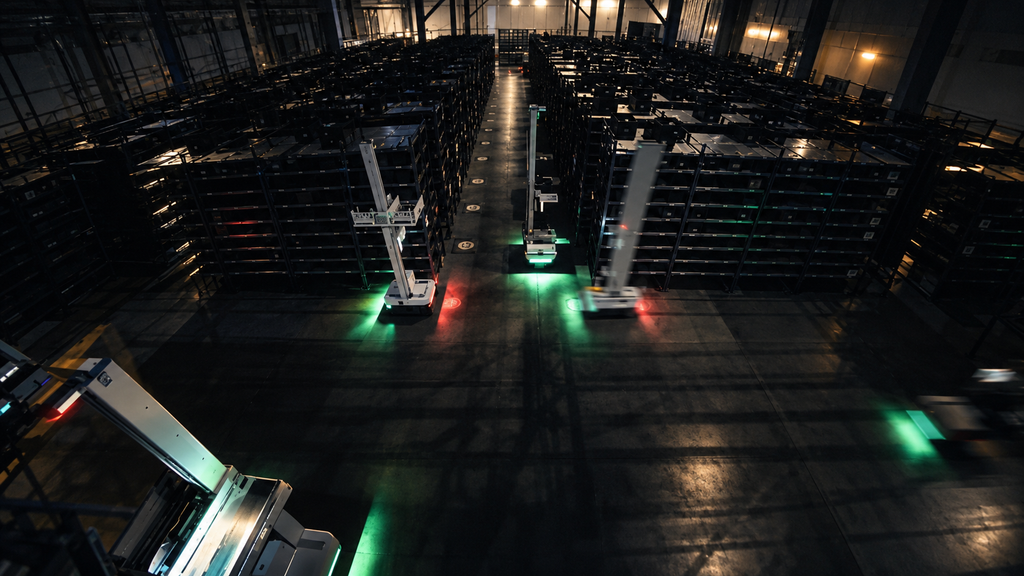
The most practical first step is a lights-out night shift. Our robots can already run for 6-8 hours without human intervention. Exceptions still occur, particularly around complex item manipulation. The important question is whether those exceptions stop the operation or can wait while the robots continue other work.
A lights-out shift does not require every order to be completed autonomously. Most exceptions can be resolved remotely through teleoperation. Orders requiring someone physically on site can be “parked” for the morning team while the robots continue picking other orders.
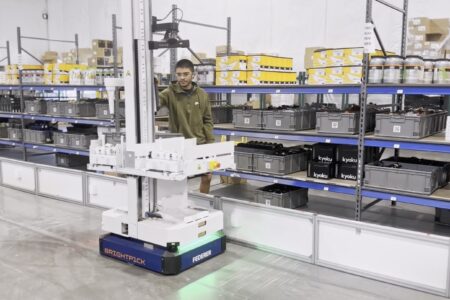
That is exactly what our customers such as The Feed are doing. At its Colorado warehouse, 103 Brightpick robots pick and buffer orders overnight. When the morning team arrives, completed orders are already staged for packing and shipping. The warehouse gains 30-50% more capacity from its existing automation with 0 added cost or labor – a huge ROI unlock.
We spend a lot of engineering effort making robots faster. But daily output depends on both hourly productivity and the number of productive hours. At the same picking rate, extending operation from 16 productive hours to 24 means 50% more throughput. That changes the value of improvements in autonomy: a software update that reduces interventions can do more than save a few minutes during a staffed shift. It can make an entire additional shift possible without adding robots.
The Feed did not need to eliminate every human task before gaining the benefit of an autonomous shift. That is the distinction that matters: a fully lights-out warehouse is the longer-term goal, but productive hours without on-site staff are already achievable with the automation and AI we have today.
As robots handle more tasks and recover from more exceptions, those unattended hours can grow. We do not need to wait until robots can do everything before we let them work while we sleep.
About Brightpick
Brightpick is a leader in AI-powered robotic solutions for warehouses. The company’s multi-purpose AI robots enable warehouses of any size to fully automate order picking, buffering, consolidation, dispatch, and stock replenishment. The award-winning Brightpick solution takes just weeks to deploy and allows companies to keep their warehouse labor to a minimum. With offices in the US and Europe, Brightpick has more than 250 employees and hundreds of AI robots deployed with customers.
- SHARE
-

-
-
-


- SHARE
-
-
-
-