Open this article in your preferred AI tool and ask it to summarize the key points.


How we minimize risk when automating your warehouse: lessons from the field
The biggest risks in warehouse automation usually appear long before the first robot arrives on site.
They start with assumptions that turn out to be wrong: order profiles that are not fully understood, SKU complexity that is underestimated, peak demand that is modeled too conservatively, software workflows that are more complex than expected, or site conditions that create installation challenges down the line.
That is why risk mitigation cannot be treated as a late-stage checklist. It has to be built into the design process from the beginning.
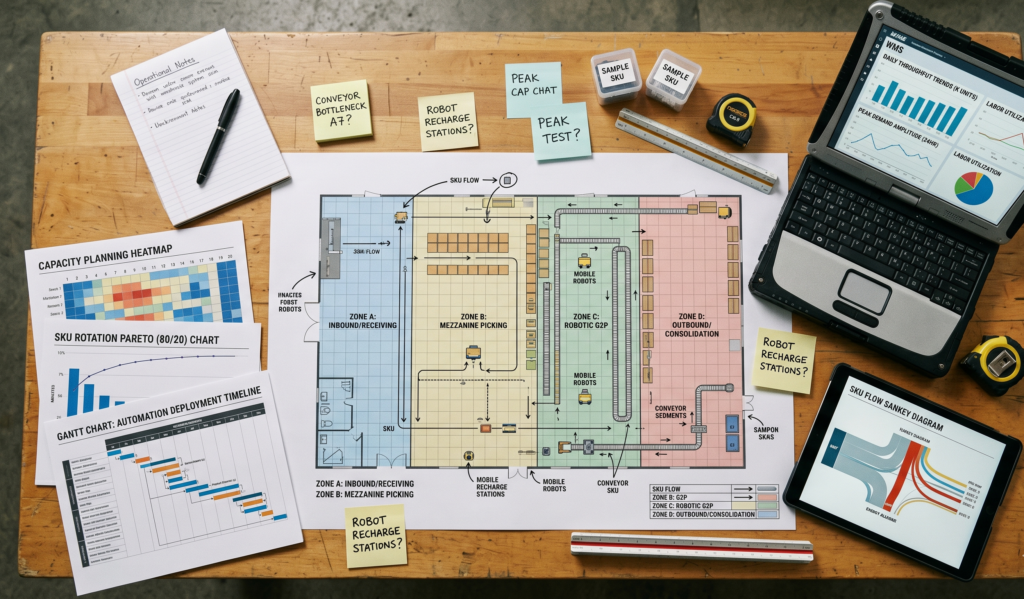
This is how we minimize risk across our warehouse automation projects at Brightpick:
1. Use the real operating profile
Before designing a Brightpick system, we analyze how the warehouse actually runs. That includes order structure, SKU mix, seasonality, intraday peaks, cut-off times, inventory requirements, current processes, and site constraints. These details matter because two warehouses with similar order volumes can require very different automation designs.
We often repeat this analysis several times during the sales and design process as customers gather better data and clarify operational details. The goal is simple: design the right system for the real operation based on the right data from the start.
2. Simulate the system before deployment
Once the solution is designed, we run detailed simulations to test how it will perform before deployment begins. This includes modeling both average and peak scenarios, because averages alone can be misleading.
Simulation helps us validate that the system is sized correctly, whether workflows can handle pressure, and where potential bottlenecks may appear. By stress-testing the design upfront, we can identify risks early and adjust the fleet size, layout, workstation configuration, or process assumptions before the system reaches the warehouse.
3. Inspect the site early
Automation deals with atoms, not just bits, so it is critical to analyze the physical space early. Floor flatness, fire suppression, electrical capacity, ceiling height, Wi-Fi coverage, and installation access can all affect the project. If these factors are discovered too late, they can cause delays, redesigns, or additional costs.
That is why site review should happen early in the process. Customers should also align with local fire authorities and insurance providers before installation. The goal is to make sure the site is ready for automation before the project moves into deployment.
4. Review the software logic before integration
Robots can only execute the work they receive from the warehouse software, so integration risk needs to be addressed early. Before integration begins, we review how the customer’s WMS is configured and how it will connect with Brightpick Intuition. That includes order release logic, picking rules, replenishment processes, inventory accuracy, exception handling, prioritization rules, cut-off times, and data quality.
The goal is to understand how automation fits into the customer’s existing operational logic before it becomes an on-site issue. This helps avoid surprises later, such as unclear task priorities, incomplete data, or process rules that do not translate cleanly into automation.
5. Stress-test software integration
Software readiness is one of the biggest factors in reducing deployment risk. That is why integration should be completed and stress-tested before on-site installation begins.
This includes making sure API communication is smooth, order flows and inventory updates work correctly, latency is minimized, exception scenarios are handled properly, recovery cases are tested, cybersecurity requirements are met, and user permissions are configured.
By validating integration upfront, teams can identify issues early, confirm that data flows correctly, and make sure the system is ready to execute real operational work from day one.
6. Split the deployment into phases when needed
When the operation allows it, a phased rollout can reduce disruption and give the warehouse a fallback path. This gives the team time to validate performance, train users, adjust processes, and build confidence before expanding the system. In practice, phasing can reduce pressure on go-live, make scaling more controlled, and help the customer move from initial deployment to full operation with lower risk.
7. Guide the team through the change
Automation is not only a technical project. It also changes how people work, so training and change management are essential to reducing risk. Warehouse teams need to understand how the system works, how exceptions are handled, what changes in day-to-day operations, and when to escalate issues. A deployment succeeds when the warehouse team can use it confidently, follow the right processes, and know how to respond when something unexpected happens.
8. Make performance measurable and accountable
Automation promises should be tied to clear assumptions and measurable KPIs. At Brightpick, throughput guarantees are based on the customer’s operating profile and agreed underlying assumptions. These assumptions matter because they directly affect system performance. Clear KPIs make success measurable, reduce ambiguity, and keep both sides aligned on what the system is expected to deliver. The goal is to make performance accountable from the start.
Conclusion: reduce risk by making automation fit reality
The most successful automation projects are not the ones with the flashiest technology. They’re the ones designed for your reality: your actual operating data, workflows, building constraints, software logic, team, and performance targets.
That is the Brightpick way: validate the system before it ever reaches the floor, deploy it in a controlled way, and make sure the operators know exactly what the system is designed to deliver.
About Brightpick
Brightpick is a leader in AI-powered robotic solutions for warehouses. The company’s multi-purpose AI robots enable warehouses of any size to fully automate order picking, buffering, consolidation, dispatch, and stock replenishment. The award-winning Brightpick solution takes just weeks to deploy and allows companies to keep their warehouse labor to a minimum. With offices in the US and Europe, Brightpick has more than 250 employees and hundreds of AI robots deployed with customers.
- SHARE
-

-
-
-


- SHARE
-
-
-
-