Open this article in your preferred AI tool and ask it to summarize the key points.


Most commonly asked questions about Gridpicker
Disclaimer: Gridpicker is not available for customers and installation in Germany
What is Gridpicker?
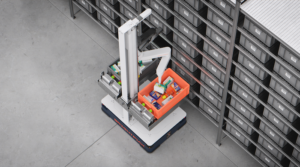
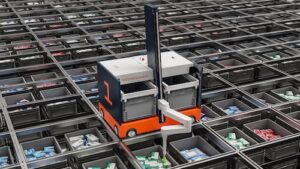
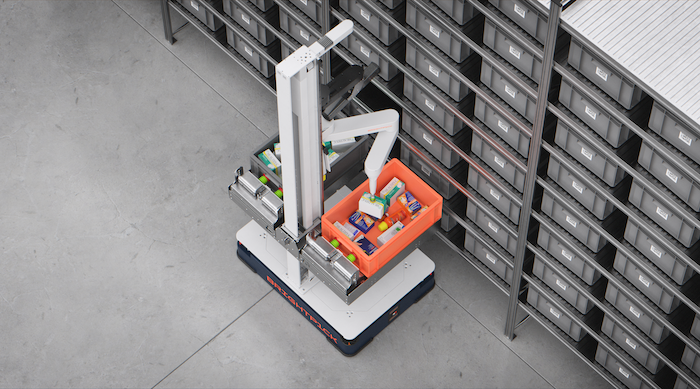
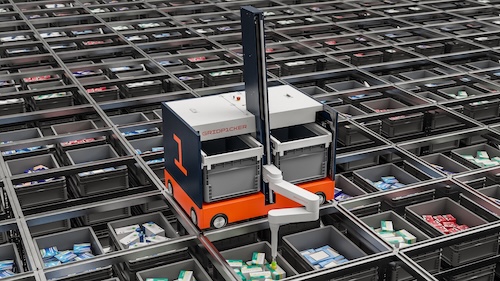
Gridpicker is a high-throughput grid-based fulfillment system run by AI-powered mobile manipulators. It is the first AS/RS system capable of fully autonomous order fulfillment without retrieving storage bins to a picking station. Gridpicker robots pick directly from storage totes and move seamlessly between picking, buffering, replenishment, and sortation tasks.
What kind of warehouses is Gridpicker best suited for?
Gridpicker is best suited for high-volume fulfillment centers for ecommerce, medical distribution, or grocery. Gridpicker handles the full range of SKU velocities from the fastest movers to less frequently picked items. The ability to handle individual items and full cases, including robotically pickable and non-pickable products, makes Gridpicker also suitable for omni-channel and B2B operations.
Gridpicker may be less suitable for small, low-volume warehouses that do not need high throughput. For those applications, Brightpick’s Autopicker robots are a stronger fit.
How fast is each Gridpicker, and how much throughput can the solution deliver?
Each Gridpicker robot picks 70 to 100 order lines per hour, outperforming both typical human pickers and other fulfillment robots. The entire solution delivers up to 10 order lines per hour per square meter, double that of shuttle systems. Actual throughput will depend on SKU mix, robotic pickability, layout, and workflow design. Gridpicker performs best in operations where a high share of SKUs can be picked robotically directly on the grid.
Why can Gridpicker achieve such high throughput?
Gridpicker is the first AS/RS system capable of fully autonomous order fulfillment without bringing storage bins to a picking station. Instead, robots pick items directly from storage totes, eliminating tote transport, reducing travel time, and accelerating picking. This approach also removes congestion within the storage area and at picking stations, allowing warehouses to deploy many more robots within the same footprint.
How does Gridpicker’s storage density compare with shuttle and cube storage systems?
Gridpicker delivers cube-level storage density when built to its maximum height of 12 meters. Similar to cube storage, Gridpicker does not require any conveyors inside the system.
How much labor does Gridpicker save?
Gridpicker reduces labor for picking and replenishment by more than 95% compared to manual operations. Compared to Goods-to-Person systems such as shuttles or cube storage, it requires 85% less labor, as most of the picking is done by the robots. Gridpicker also enables lights-out night shifts with zero staffing, as robots pick and buffer orders fully autonomously.
Does Gridpicker support human picking?
Gridpicker supports goods-to-person picking for items that cannot be picked robotically. Gridpicker robots transport both the storage tote and order tote to a picking station, where a human operator completes the pick. Each goods-to-person station can deliver up to 300 order lines or tote presentations per hour.
Gridpicker is the only system whose cost decreases as automation increases. As more SKUs become suitable for robotic picking, each mobile manipulator becomes more productive and fewer robots are required to achieve the same throughput, reducing system cost.
How do Gridpicker robots access totes stored at lower levels?
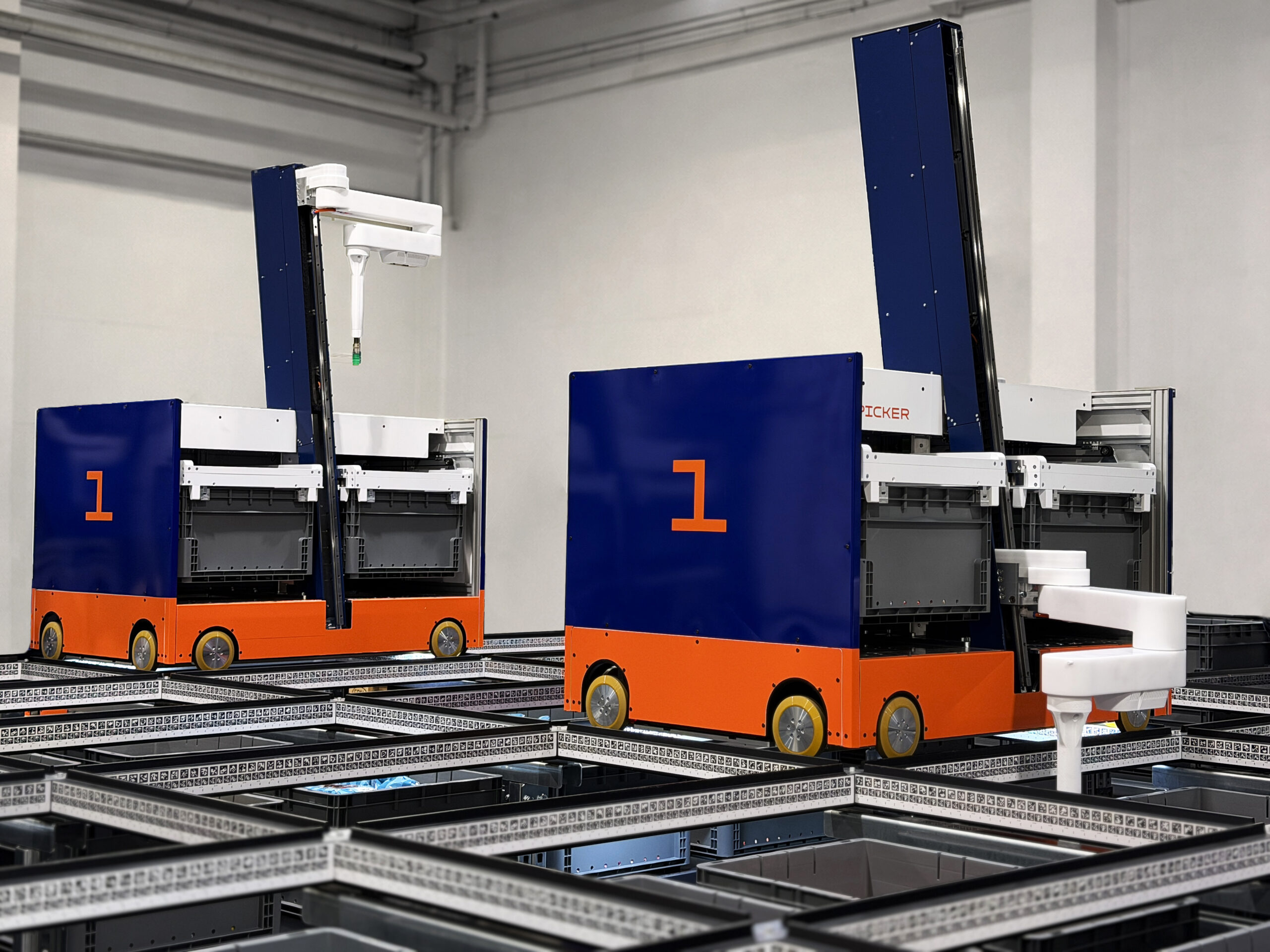
Gridpicker robots operate on top of a grid positioned above modular warehouse shelving. Within each aisle, Fetcher robots move between the shelves on fixed rails attached to the racking. These lightweight robotic trays bring totes from storage to the top level, where they are immediately accessible for Gridpicker robots to pick from.
Dynamic slotting, powered by Brightpick’s Intuition software, ensures each tote is positioned exactly where it is needed for immediate picking. Each aisle has multiple Fetchers to ensure no single point of failure.
How much does Gridpicker cost?
Pricing for Gridpicker depends on specific project requirements and operating assumptions. Typically it is about 30% more cost-effective than shuttle systems and roughly 10% more cost-effective than cube storage solutions, while delivering significantly higher labor savings through robotic picking.
How does Gridpicker compare to shuttle systems?
Compared to shuttle systems, Gridpicker delivers up to 2x the throughput while requiring 85% less labor and costing 30% less. Unlike shuttle systems, Gridpicker robots pick items directly from storage totes, eliminating the need to transport items to picking stations. Moreover, Gridpicker is simpler to install and scale and does not have any single point of failure.
How does Gridpicker compare to cube storage systems?
Compared to cube storage systems, Gridpicker delivers up to 3x the throughput while requiring 90% less labor. Unlike cube systems, Gridpicker robots pick items directly from storage totes, eliminating the need to transport items to picking stations. Gridpicker achieves storage density on par with cube storage systems.
About Brightpick
Brightpick is a leader in AI-powered robotic solutions for warehouses. The company’s multi-purpose AI robots enable warehouses of any size to fully automate order picking, buffering, consolidation, dispatch, and stock replenishment. The award-winning Brightpick solution takes just weeks to deploy and allows companies to keep their warehouse labor to a minimum. With offices in the US and Europe, Brightpick has more than 250 employees and hundreds of AI robots deployed with customers.
- SHARE
-

-
-
-


- SHARE
-
-
-
-