
Open this article in your preferred AI tool and ask it to summarize the key points.


Which warehouse automation systems are easiest to implement?
The benefits of warehouse automation are clear. Getting there, however, isn’t always easy.
Depending on the technology you choose, automating an existing warehouse can mean anything from introducing robots into your current operation to rebuilding large parts of your facility.
How easy a system is to install affects not only the upfront cost and deployment time, but also how much it disrupts daily operations, how quickly you can reach full capacity, and how soon your investment starts paying off.
So which warehouse automation systems are the easiest to implement, and what are the trade-offs?
1. Assisted picking AMRs
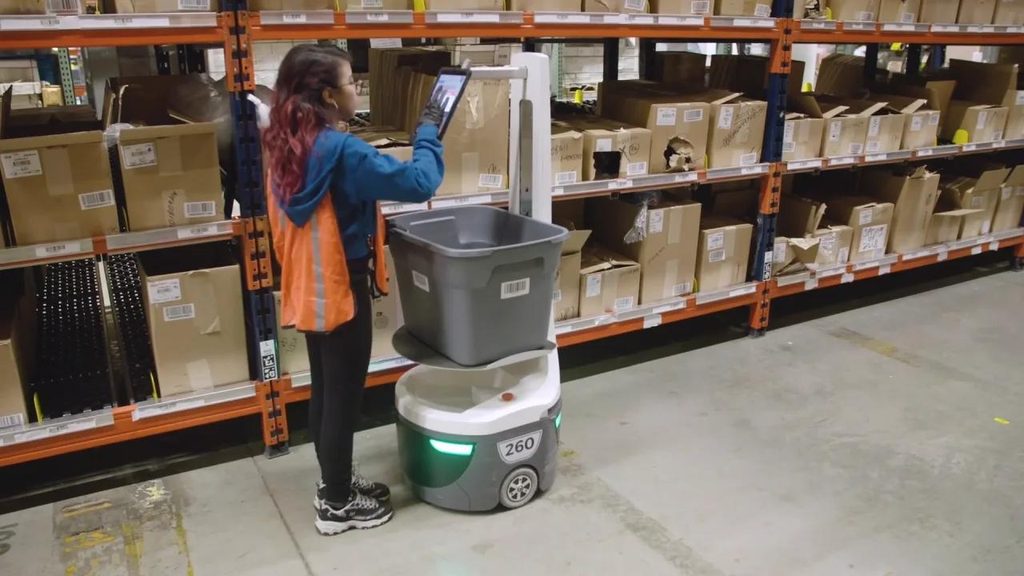
Assisted picking AMRs are generally among the easiest warehouse automation systems to implement.
Assisted picking robots carry orders between pick locations while people continue to pick from shelves, cases or pallets. This reduces travel distances for human pickers and increases labor productivity.
Since these systems still rely on human pickers, the existing warehouse layout, shelving and storage methods typically don’t need to change.
Similarly, customers deploying assisted picking AMRs usually don’t need to upgrade their fire suppression systems, improve floor flatness or install safety fencing around the automation. This makes assisted picking AMRs particularly well suited to brownfield sites.
These benefits, however, come with trade-offs. Because assisted picking AMRs still rely on humans picking within the storage area, they offer limited labor savings, no improvements in storage density, and limited potential for increasing overall warehouse throughput compared to a manual operation.
Who they are best suited for: Existing warehouses looking to improve labor productivity with minimal investment and operational disruption.
What is needed for deployment: Mapping the operating area for robot navigation and integrating the robot management software with the existing WMS.
2. Shelf-to-person AMRs
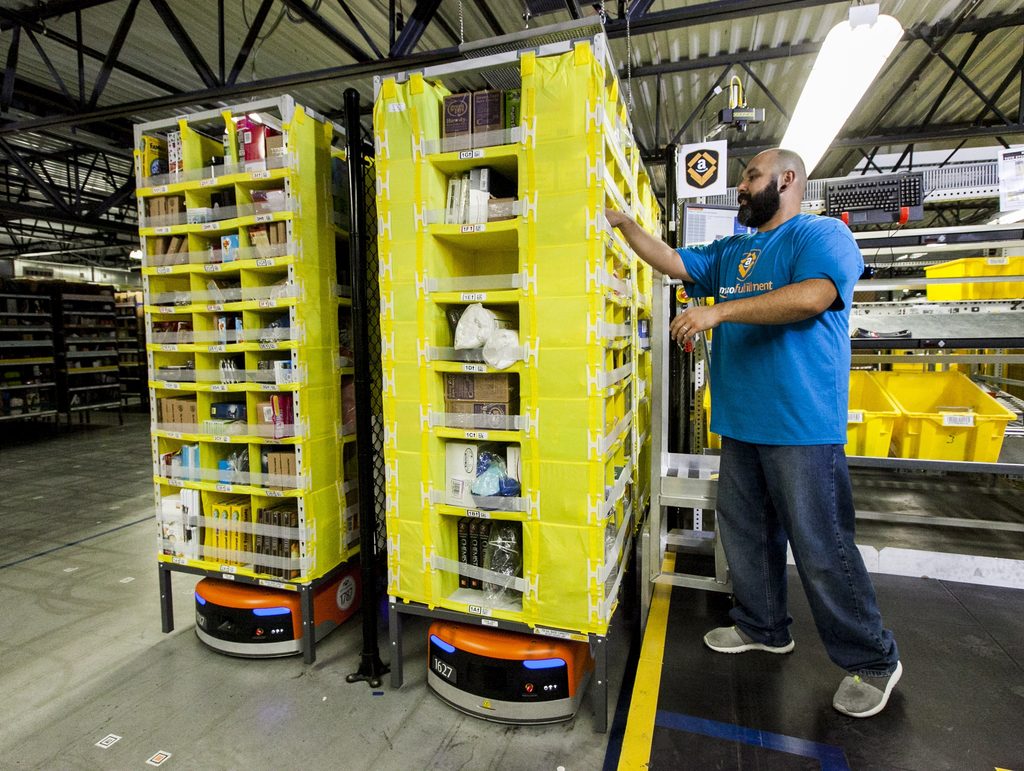
Shelf-to-person AMRs are relatively easy to implement but require more changes to the existing warehouse layout than assisted picking AMRs.
These robots bring entire mobile shelves to goods-to-person (G2P) stations, eliminating the need for human pickers to walk through the storage area.
Such solutions use simple mobile shelves instead of fixed racking, and inventory does not need to be transferred into standardized totes. Floor flatness requirements are generally less demanding than those of systems using tall storage racks.
However, customers need to transfer their inventory onto mobile shelves and typically fence off the robot operating area.
Storage density is relatively low due to limited shelf height, and the system still relies on human pickers at G2P stations.
Who they are best suited for: Warehouses looking to reduce picking labor without installing complex storage infrastructure, where storage density is not a priority.
What is needed for deployment: Installing mobile shelves, picking and charging stations, safety fencing, setting up robot navigation and integrating the robot management software with the existing WMS.
3. Tote-to-person AMRs
Tote-to-person AMRs are relatively easy to scale but require more extensive changes to the existing warehouse infrastructure than shelf-to-person AMRs.
Rather than moving entire shelves, these robots retrieve individual totes from storage racks and deliver them to G2P stations.
By making better use of the building’s height, tote-to-person AMRs offer higher storage density. Some systems, such as shelf-climbing AMRs, can also deliver high throughput.
These benefits, however, come with additional installation requirements.
Customers need to install compatible storage racks, transfer inventory into standardized totes and typically fence off the robot operating area.
Depending on the system and storage height, customers may also need to improve floor flatness, meet stricter rack installation tolerances or upgrade their fire suppression systems. These solutions also still require human pickers at G2P stations.
Who they are best suited for: Warehouses looking to increase storage capacity within their existing footprint while reducing picking labor.
What is needed for deployment: Installing storage racks, totes, picking and replenishment stations, charging stations and safety fencing, setting up robot navigation, and integrating the robot management software with the existing WMS.
4. Mobile manipulators
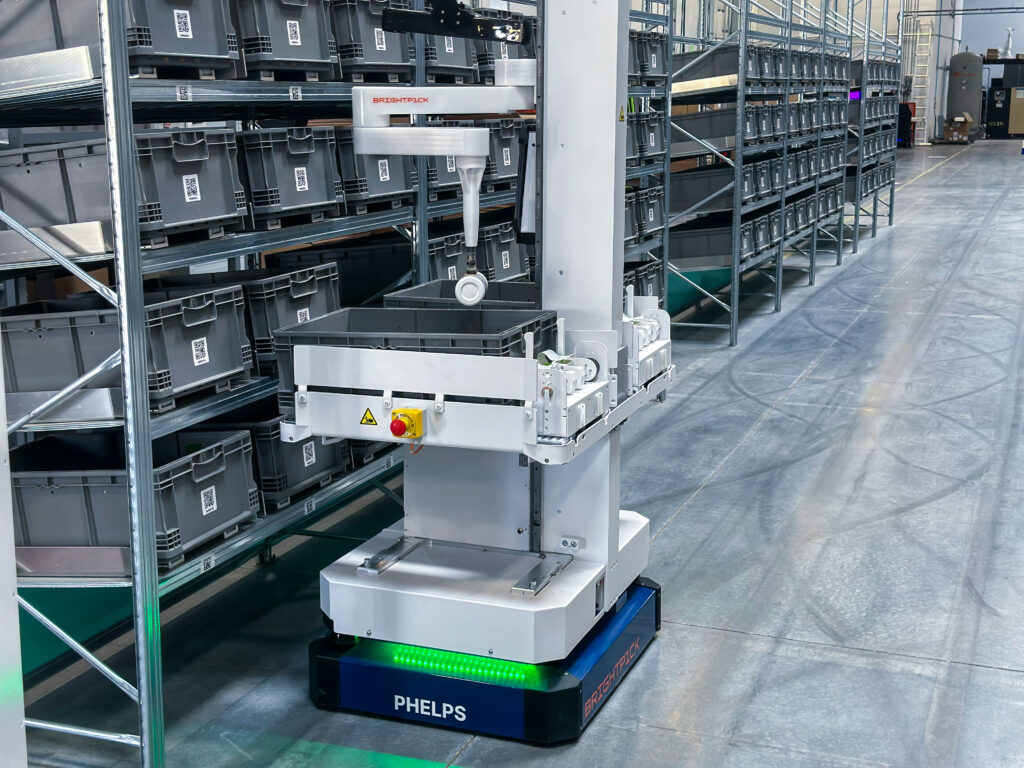
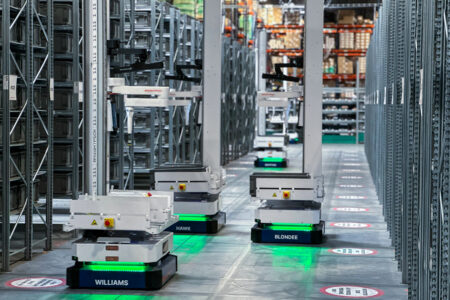
Mobile manipulators have similar installation requirements to tote-to-person AMRs but automate more of the picking process.
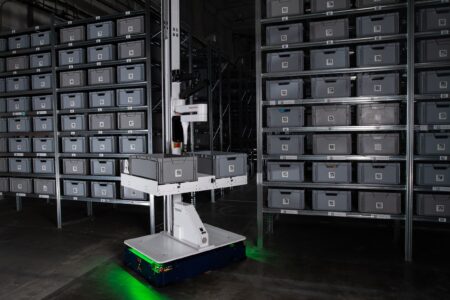
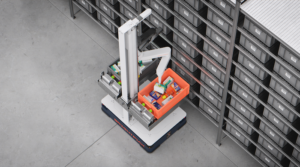
Mobile manipulators retrieve inventory totes and pick individual items directly in the storage aisle. This eliminates unnecessary transport and handoffs between robots and human pickers.
By combining inventory retrieval and item picking in a single robot, mobile manipulators can deliver high throughput and storage density while offering greater labor savings than conventional goods-to-person systems.
Similar to tote-to-person AMRs, customers need compatible shelving and totes and may need to adjust their existing warehouse layout. Some systems, such as Brightpick Autopicker, use standard shelving and totes and have no special electrical, fire suppression, or safety fencing requirements, simplifying installation and improving scalability.
Some human pickers are still needed to handle items that robots cannot pick autonomously, although considerably less manual picking is required than with other AMR systems.
Who they are best suited for: Warehouses looking to maximize labor savings, storage density and throughput without installing fixed automation infrastructure.
What is needed for deployment: Installing compatible shelving, totes, replenishment and charging stations, assessing SKU pickability, integrating the robot management software with the existing WMS.
When is fixed automation worth the extra work?
Fixed automation systems such as conveyors, shuttle systems, and cube storage generally require more extensive changes to the warehouse infrastructure.
Conveyors need dedicated routes, structural supports, and electrical connections. Shuttle and cube storage systems require specialized storage structures and typically require extensive upgrades to the warehouse floor, power supply, and fire suppression systems.
The additional investment and longer deployment time can be justified in operations with high, predictable volumes or demanding throughput and storage density requirements.
However, fixed automation is generally more difficult and expensive to relocate or reconfigure. Before investing, consider how long you plan to operate in your existing facility and how your storage and fulfillment needs may change over time.
Look beyond installation time
When comparing warehouse automation systems, consider the entire deployment process, from site preparation and equipment installation to software integration and ramp-up.
If you’re automating an existing warehouse, ask vendors how much of the installation can take place without interrupting daily operations. Our guide to automating a brownfield warehouse covers this in more detail.
The easiest system to install isn’t necessarily the best fit for your operation. A more demanding installation may be worth the extra effort if it delivers significantly greater labor savings, storage capacity or throughput.
Ultimately, the goal is to find a system that delivers the operational improvements you need while minimizing upfront costs, disruption and time to value.
About Brightpick
Brightpick is a leader in AI-powered robotic solutions for warehouses. The company’s multi-purpose AI robots enable warehouses of any size to fully automate order picking, buffering, consolidation, dispatch, and stock replenishment. The award-winning Brightpick solution takes just weeks to deploy and allows companies to keep their warehouse labor to a minimum. With offices in the US and Europe, Brightpick has more than 250 employees and hundreds of AI robots deployed with customers.
- SHARE
-

-
-
-


- SHARE
-
-
-
-