Open this article in your preferred AI tool and ask it to summarize the key points.


Best robotic warehouse systems for high throughput fulfillment
A picking station capable of processing 1,000 order lines per hour sounds impressive. But how much warehouse space, robots, and infrastructure does it take to keep that station running at full capacity?
Warehouse automation vendors often highlight picking station performance, but that tells only part of the story. For operators looking to increase fulfillment capacity, a more useful measure is how many orders a system can fulfill in a given warehouse footprint.
By far the biggest constraint to throughput is robot congestion. Beyond a certain point, adding robots delivers diminishing returns and can even reduce overall system efficiency as too many robots start slowing each other down.
Different automation technologies approach these limitations in different ways. Here’s how five common systems for high-throughput order fulfillment compare to each other.
| Automation system | Max throughput (order lines picked / m² / hour)* |
|---|---|
| Shuttle systems | 6 |
| Mobile Manipulators | 10 |
| Cube storage | 4 |
| Shelf-climbing AMRs | 3 |
| A-Frames | 20 |
*Indicative maximum throughput figures. Actual performance depends on system configuration, warehouse layout, SKU mix, and operating conditions.
1. Shuttle systems
Shuttle systems, such as Dematic Multishuttle and KNAPP EVO Shuttle, are among the strongest options for high-volume fulfillment.
Their main advantage is parallel operation. With dedicated shuttles operating at each level in each aisle, inventory can be retrieved quickly without the traffic problems associated with large fleets of freely moving robots. Fast conveyors can then feed products to high-performance picking stations.
However, throughput is still constrained by the infrastructure connecting storage to picking. Every retrieved tote must pass through lifts, conveyors, and picking stations, each with its own capacity limits.
Increasing throughput beyond those limits requires additional infrastructure and sophisticated software, adding cost and complexity to the operation.
Best suited for: Stable, high-volume operations that can justify substantial investment in fixed automation infrastructure.
2. Mobile manipulators
Mobile manipulators take a fundamentally different approach to fulfillment.
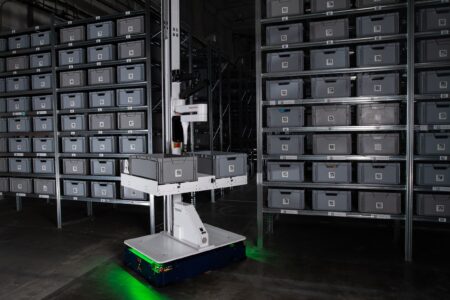
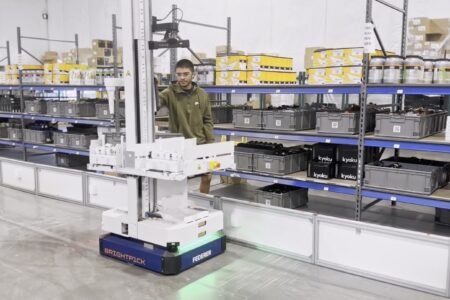
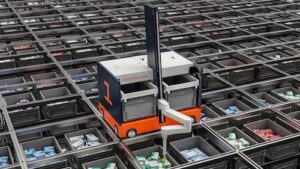
Instead of transporting inventory to centralized picking stations, robots such as Brightpick Autopicker travel to the products and pick individual items directly inside the storage area.
This changes the throughput equation.
By picking inside the storage area, mobile manipulators avoid much of the back-and-forth travel required by traditional Goods-to-Person systems. Robots spend less time transporting inventory, while picking activity is distributed throughout the warehouse rather than concentrating at a limited number of stations.
As a result, the system can support higher throughput, because the robots don’t need to travel so much, they don’t slow each other down and also do not run into congestion issues around picking stations.
Advances in AI, computer vision, and robotic manipulation are continuously expanding the range of products robots can handle. Over time, the goal is to make virtually every item in a warehouse robotically pickable, progressively reducing the need for human intervention.
Best suited for: Fulfillment operations with a high share of robotically pickable products.
3. Cube storage
Cube-based systems, such as AutoStore, are designed to store large quantities of inventory within a compact footprint.
Robots travel on a grid above the storage, retrieving totes vertically and delivering them to picking stations. With no aisles needed inside the storage area, cube systems can achieve excellent storage density.
However, storage density and picking throughput aren’t necessarily the same thing.
Because totes are stacked vertically, accessing products deeper in the grid requires first removing the totes above them, a process known as digging. Depending on the order profile, these additional movements can consume substantial robot capacity and slow them down.
Intelligent inventory placement can minimize digging by keeping frequently requested products near the top. Nevertheless, as storage depth increases, maintaining high throughput can become more challenging, particularly for operations with a broad or changing SKU mix.
The number and capacity of picking stations also affect overall performance.
Best suited for: Operations prioritizing storage density or with a flat Pareto curve where a small minority of items account for most of the picks.
4. Shelf-climbing AMRs
Shelf-climbing autonomous mobile robots, such as Exotec Skypod, combine fast ground travel with the ability to retrieve totes from elevated storage locations.
One advantage is routing flexibility. Robots can travel below shelving and take different paths through the storage area, helping reduce congestion. Their ability to access high racks also makes efficient use of vertical warehouse space.
The trade-off comes from the retrieval process.
Robots must travel to the required storage location, climb to retrieve the tote, return to ground level, and transport it to a picking station. While the robots can move quickly, these operations still consume substantial time during each retrieval cycle.
As with other Goods-to-Person systems, throughput ultimately depends on how efficiently the robot fleet can supply picking stations without excessive traffic or waiting times.
Best suited for: Operations seeking a combination of flexible automation, vertical storage utilization, and high-performance G2P picking.
5. A-frames
A-frame systems are a special case. They can achieve extremely high picking rates, but only for certain types of products, primarily pharmaceuticals.
Solutions such as the SSI SCHAEFER A-Frame use automated dispensers to release individual products onto a conveyor, making them particularly effective for high-volume pharmaceuticals, cosmetics, and other small, neatly-packaged items.
Because products are dispensed directly, there is no need for robots to travel between storage locations and picking stations.
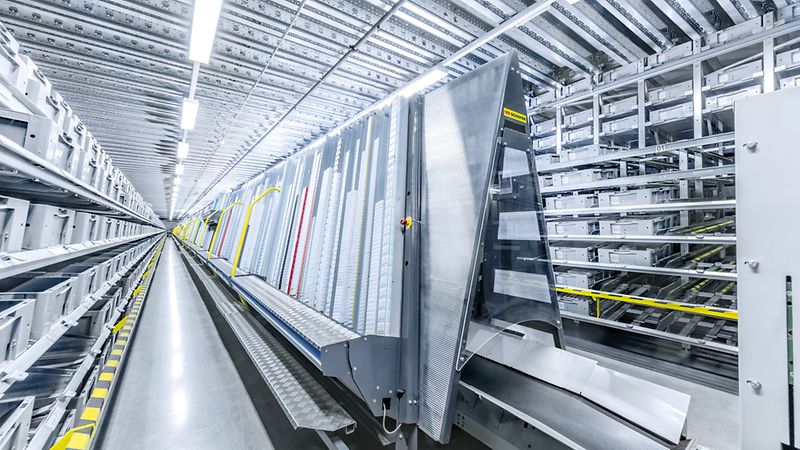
The limitation is product suitability and replenishment. A-frames typically require substantial manual effort to refill dispensing channels, and not every product can be handled by the system. The shared conveyor infrastructure must also support the required throughput.
For this reason, A-frames are always used alongside other fulfillment technologies rather than as a complete warehouse automation solution.
Best suited for: Pharmaceutical distribution, where large volumes of small, standardized packages need to be picked quickly and reliably.
Why higher throughput matters
Higher throughput per square meter allows warehouses to process more orders within the same footprint.
For growing businesses, this can mean avoiding the need for additional fulfillment centers, along with the costs of new infrastructure, labor, and the added complexity of managing inventory and distribution across multiple locations.
Ultimately, the goal isn’t simply to achieve the fastest picking speed, but to maximize the volume a facility can handle without expanding the fulfillment network.
About Brightpick
Brightpick is a leader in AI-powered robotic solutions for warehouses. The company’s multi-purpose AI robots enable warehouses of any size to fully automate order picking, buffering, consolidation, dispatch, and stock replenishment. The award-winning Brightpick solution takes just weeks to deploy and allows companies to keep their warehouse labor to a minimum. With offices in the US and Europe, Brightpick has more than 250 employees and hundreds of AI robots deployed with customers.
- SHARE
-

-
-
-


- SHARE
-
-
-
-