What the AI Bubble Narrative Gets Wrong
Guest post by Brightpick CEO Jan Zizka
Bubbles form when expectations race far ahead of reality.
There is no doubt that expectations for AI are sky-high. It is supposed to transform industries and reshape economies. Every company now has an “AI strategy.”
But is AI actually delivering enough value inside real operations to justify this excitement?
To answer that, look at one of the toughest proving grounds: robotics.
A short history of AI in robotics
Robotics has been evolving from rigid, rule-based systems to adaptive machines from the very beginning.
The first large-scale use of AI in robotics came through vision-guided industrial systems, beginning in the 1990s. Manufacturers integrated ML-based vision into robotic arms for inspection, part localization, and guidance, enabling robots to handle greater variability.
As perception improved, AI moved into manipulation. Random bin picking became commercially viable as advances in 3D vision and machine learning allowed robots to reliably identify and grasp previously-unseen objects.
Early systems relied on task-specific ML. Today’s AI wave increasingly centers on the promise of generative AI and vision-language-action models enabling more general, adaptable robots that don’t require manual engineering.
What buyers actually care about
Flashy demos and pilots may generate excitement, but they do not drive long-term adoption. At scale, robotics is evaluated like any other capital investment: against measurable ROI and operational reliability.
CFOs ask rigorous questions about total cost reduction, scalability, and ongoing operating expenses. COOs, meanwhile, focus on uptime, consistency, serviceability, and integration. In production environments, sustained performance matters far more than technical novelty.
This is where the gap between different AI-enabled approaches becomes clear.
AI in robotics today
In practice, AI in robotics today falls into three categories:
1) Improving existing systems
These are robots already embedded in real operations, performing repetitive tasks with measurable output. AI is used to increase performance rather than redesign the workflow.
Typical improvements include:
- More robust perception in applications such as quality inspection and bin picking
- Better generalization to edge cases and variability
- Greater tolerance to variation in object shape, color, and lighting conditions
- Reduced dependence on precise fixturing and tightly controlled scenes
The result is not a new category of applications, but improved resilience in existing ones.
Companies such as Vention and RobCo illustrate this shift. By combining AI-assisted setup, low-code programming, and teach-by-demonstration, they reduce deployment time and engineering overhead. Industrial arms become more software-defined and faster to reconfigure, increasing flexibility without sacrificing reliability.
2) Enabling new system architectures
AI can also enable entirely new operating models for repeatable work.
The clearest example is the combination of manipulation and mobility. Mobile manipulators integrate navigation, perception, and grasping, allowing robots to move through open environments and perform multiple tasks rather than remaining confined to a fixed workflow.
This unlocks new capabilities such as:
- Performing picking, replenishment, or kitting across dynamic warehouse environments
- Handling tasks in semi-structured spaces without rigid infrastructure
- Adapting to layout changes without full reprogramming
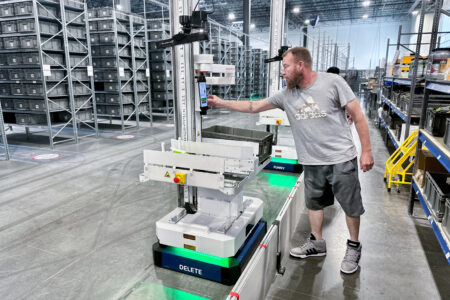
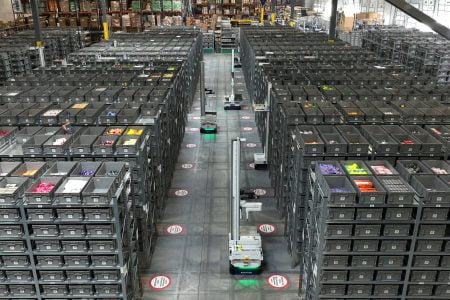
Robots such as Brightpick’s Autopicker and Boston Dynamics’ Stretch illustrate this shift. By combining autonomy, perception, and manipulation in a single platform, they enable automation models that were previously impractical with fixed industrial cells.
3) Achieving true generality
This is the frontier of AI in robotics: systems capable of handling almost any workflow.
Such robots would not be limited to narrowly defined, repeatable tasks or tightly controlled environments. They could adapt across multiple workflows within a warehouse or factory, and over time potentially extend into less structured domains such as homes or public spaces.
Today, however, no truly general robotic system operates at scale in production environments. Most efforts remain confined to labs, pilot programs, or tightly scoped deployments, limited by performance, reliability, safety, and demonstrable ROI.
Seeing through the hype
So is AI delivering enough value inside real operations to justify the excitement?
Yes, but not where the headlines suggest.
When AI improves existing systems or enables new system architectures, it is already achieving measurable ROI and adoption at scale. These applications are operating in production environments today.
True generality remains distant from mass commercialization, constrained by reliability, safety validation, and clear economic proof. But that does not diminish the real progress already underway. AI-enabled advances in perception, robustness, and deployment flexibility are reshaping production robotics long before general-purpose autonomy arrives.
Hype will rise and fall. What endures are systems with real deployments, clear unit economics, and CFO-grade validation. The future of AI in robotics will be decided not by headlines, but on factory floors, warehouse aisles, and balance sheets.
About Brightpick
Brightpick is a leader in AI-powered robotic solutions for warehouses. The company’s multi-purpose AI robots enable warehouses of any size to fully automate order picking, buffering, consolidation, dispatch, and stock replenishment. The award-winning Brightpick solution takes just weeks to deploy and allows companies to keep their warehouse labor to a minimum. With offices in the US and Europe, Brightpick has more than 250 employees and hundreds of AI robots deployed with customers.
- SHARE
-

-
-
-


- SHARE
-
-
-
-